
“Portfolio insurance” is a useful search phrase, but it can create the wrong expectation. A hedge is not automatically an insurance policy issued by an insurer. Options can reshape a price payoff for a defined period, subject to contract and settlement conditions. They do not necessarily cover custody failures, unavailable withdrawals, or the loss of a different token.
This guide compares a protective put with a collar using a fictional asset and simplified European-style, cash-equivalent payoffs at expiry. It assumes matching exposure and ignores fees, taxes, interest, and counterparty failure unless noted. Those assumptions are important: the figures describe mathematical examples, not available offers. See the portfolio insurance overview for the distinction between price protection and other forms of cover.
1. Define the protection precisely
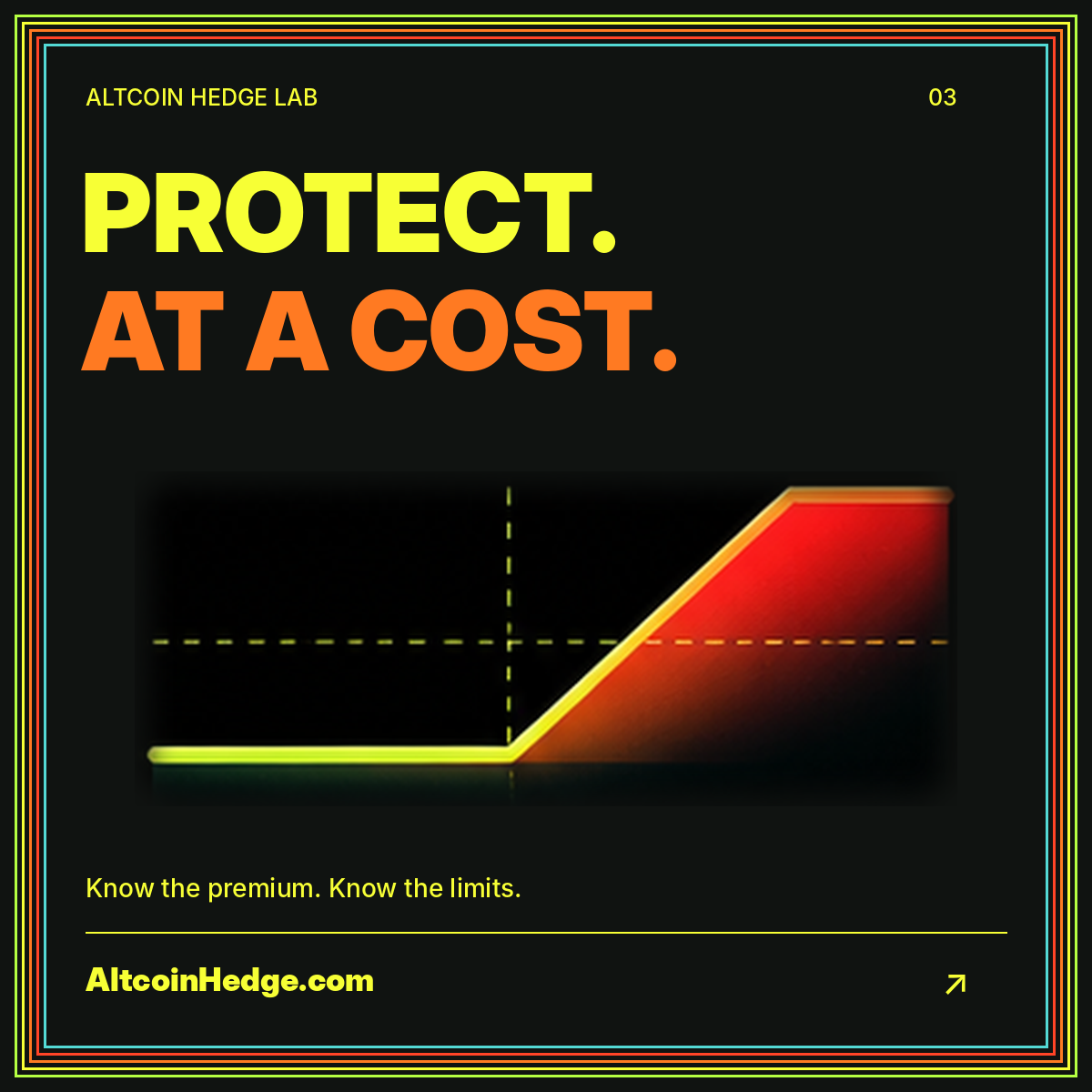
A protective put combines a long position in an asset with a purchased put option. The put's expiry payoff depends on the difference between its strike and the reference price when that difference is positive. The premium paid for the option is a separate cost. Protection has a starting point, an end date, and a defined underlying reference.
A collar adds a sold call to the long asset and purchased put. The call premium can offset some or all of the put premium, but the call creates an obligation and limits the combined upside above its strike. A low net premium is therefore a trade-off, not free protection.
The Options Industry Council's protective collar explanation describes this structure for stock positions. Applying the same payoff concept to a crypto exposure requires a separate check of the actual contract's reference, multiplier, exercise rules, and settlement asset. Stock-option mechanics cannot simply be assumed to apply unchanged.
2. Calculate a protective put at expiry
Assume one unit of a fictional asset costs $100. A put with a $90 strike costs $4 and covers exactly one unit. The combined initial outlay is $104. At expiry, suppose the asset is worth $60. The asset plus the put's $30 payoff is worth $90, producing a $14 loss against the original outlay.
If the asset instead finishes at $100, the put expires without an intrinsic payoff and the combined loss is $4. If it finishes at $130, the asset is worth $130 and the combined gain is $26. Above the strike, the premium remains a cost relative to holding the asset without the option.
Under the stated assumptions, the maximum expiry loss is $100 + $4 − $90 = $14 per unit. Calling the strike a “floor” without mentioning premium can obscure this result. The floor refers to the combined terminal value in the simplified model, not a guarantee that no money can be lost.
3. Calculate what changes with a collar
Keep the same $100 asset and $90 put costing $4. Now sell a matching $115 call and receive a $3 premium. The net option premium is $1, and the combined initial outlay is $101. The short call trades away some upside in return for reducing the upfront cost.
At an expiry price of $60, the asset plus put payoff is still $90, while the call has no intrinsic payoff. The combined loss is $11. At $100, both options expire without intrinsic value and the loss is $1. At $130, the short call owes $15, leaving a combined terminal value of $115 and a $14 gain.
The modeled maximum gain is $115 − $101 = $14, and the modeled maximum loss is $101 − $90 = $11. These are hypothetical expiry results. They assume both options cover the asset exactly and settle as modeled. An uncovered or mismatched short call is a different exposure, not a harmless variation of the same example.
4. Match the contract to the portfolio
A put on one reference asset does not provide the same payoff floor for a basket of unrelated altcoins. If the basket declines more than the reference, the option may offset only part of the loss. If the reference does not fall below the strike, the put may expire without a payoff even while the basket suffers.
Check contract units carefully. One contract may cover multiple units, use an inverse payoff, or settle in an asset whose own value changes. A dollar amount displayed on a trading screen is not enough to establish the economic match. Read the multiplier, settlement index, exercise process, and expiry time together.
For the sold call in a collar, confirm how the obligation is secured. Holding a related token in an external wallet does not necessarily make an exchange treat a short option as covered. The hedge-ratio discussion is useful when comparing direct hedges with proxies.
Ask what must happen for the option to settle. Is exercise automatic, does the holder need to submit an instruction, and which deadline applies? Who supplies the reference price if the usual feed is unavailable? Those details can affect whether the modeled payoff is realized and should be confirmed from the actual contract.
5. Account for the path before expiry
The examples describe expiry, but a real portfolio may need to close earlier. Before expiry, option prices reflect remaining time, the market's volatility assumptions, and other contract-specific factors. The combined position's quoted value can therefore differ from the simple terminal payoff diagram.
An early exit also crosses actual bid and ask prices. A displayed midpoint is not a guaranteed execution price. If the legs are closed separately, the portfolio may briefly have a different risk profile. Closing the asset while leaving the short call open, for example, can remove the economic offset that made the original collar coherent.
Document the sequence for changing or closing the position. Decide how to handle expiry when the underlying asset cannot be moved promptly. A plan that assumes instant settlement across separate platforms may fail operationally even when the theoretical payoff is well understood.
6. Compare the cost with simpler alternatives
The relevant comparison is not merely between two option premiums. Consider reducing the original exposure, shortening the investment horizon, or avoiding a position that requires protection too expensive for the budget. Each alternative has its own costs and consequences, including the potential loss of later upside.
For repeated put purchases, measure total premiums across the planned horizon rather than viewing each small payment in isolation. For repeated collars, examine the cumulative upside surrendered as well as the premium saved. Rolling a hedge means entering a new contract at new market terms, not extending the original protection for free.
The Altcoin Hedge Strategies page compares these structures with direct position reduction and linear hedges. None is universally preferable. The appropriate question is which trade-offs match a clearly stated objective and can actually be maintained with the available resources.
Questions about “insurance” language
Does a put cover an exchange failure?
Not by its ordinary price payoff alone. A price derivative and a custody protection contract address different events. If the option and the asset depend on the same failed venue, the theoretical gain may not be accessible. Examine claim rights and settlement arrangements separately from the payoff chart.
Is a zero-premium collar costless?
No. Even when premiums offset at entry, the sold call exchanges future upside for that premium. Fees, spreads, collateral obligations, and operational costs can remain. “Zero net premium” describes one component of entry pricing; it does not describe the full economic cost.
Conclusion: read the conditions around the floor
Puts and collars are tools for changing a specified payoff, not synonyms for safety. A meaningful comparison identifies the protected asset, strike, expiry, premium, settlement conditions, and retained risks. It also tests what happens when the position must close early.
The clearest protection statement is narrow enough to verify. Replace “This portfolio is insured” with an explanation of which reference-price losses the contract is designed to offset, for how long, and under which assumptions. That language makes costs and limitations visible before the hedge is needed.


